Monday, April 19, 2010

SLIS 5420 - Module 12 - Book Blog - I Am Scout


To Kill a Mockingbird is a great piece of literature and this biography of it's author dives into the background of the book. It gives an amazing amount of insight in the life of Harper Lee. She began writing at a very young age with her best friend, Truman Capote. The biography helps explain many things about the characters in Mockingbird and helps anyone who's read that book to have a better understanding of both the fictional characters and the real ones they are based on. I'd highly recommend this book to anyone who loves Mockingbird.

Library Uses
This book would be wonderful for author studies and to help students who are struggling to find something to write about. This is a great example of "writing what you know"
 

Reviews

Children's Literature

AGERANGE: Ages 12 to 16.
Adapted from his award-winning biography, Mockingbird: A Portrait of Harper Lee, this middle reader benefits from the extensive research previously undertaken by the author. Archival records, correspondence, newspaper articles, and interviews have all been mined to add personal color to this story of a very unorthodox young girl and woman. Nelle Harper Lee befriended Truman Capote at age seven; in fact the book opens with her defending Truman from bullies. Together they create a world filled with literature, immersing themselves in books, and after Lee's father gave them a typewriter jumping into writing as well. Truman's mother resurfaces a few years later and takes him to New York City, but they continue to see each other during the summers and then reconnect when she moves to the city as an adult. A thinly disguised Monroeville, the small Alabama town where she grew up and to which she returned in later life, served as the setting of her Pulitzer prize winning book, To Kill a Mockingbird. Her family relationships also shaped her work, and the main character is clearly modeled on her adored father. Probably less well known is the key role she played in Capote's own literary success, In Cold Blood. Mockingbird was the meteoric start and the culmination of Lee's literary career; the reader is led to believe that the success of her first book was so unexpected and so huge, that she lost the nerve to try writing anything else. Lee became an even more private person after her book was made into a movie, seldom granting interviews; yet this biography is rich in detail, supplemented with several black-and-white photos that helpthe reader know Lee better. This would certainly be an accessible model to use in a biography writing segment, and would be a wonderful supplement to reading To Kill a Mockingbird. Reviewer: Paula McMillen, Ph.D.

School Library Journal

Gr 6 Up- This biography is a reworking of the best-selling Mockingbird (Holt, 2006), adapted for young adults. Shields spotlights Lee's lifelong friendship with Truman Capote and the creation of To Kill a Mockingbird , showing how the publication and success of that book affected the rest of her life. Shields uses previously conducted interviews with Lee and her family, friends, and neighbors. He pulls from books, magazine articles, newspapers, and radio and television interviews to piece together this life story of the notoriously press-shy Lee. The author's clear and appealing style is much the same as in Mockingbird and this adaptation appears to have been not so much edited as streamlined. Photos include Lee, her family, friends, and the famous Hollywood actors who made the film version of her book. I Am Scout moves along at a good pace, and Lee's quiet life makes for a surprisingly fascinating read. Perhaps because Shields is pulling from so many sources, the occasional turn of phrase comes across as oddly formal, but generally, this is an immensely readable, intriguing tale of a quiet, private author.-Geri Diorio, The Ridgefield Library, CT

SLIS 5420 - Module 11 - Book Blog - An Egg is Quiet


An Egg is Quiet is a beautifully illustrated book that I happen to check out right around Easter time. My two year old son, Henry was quite fascinated by eggs and this book was perfect to share with him. I especially love the two page spreads of first the eggs and then the birds/animals that hatch from those eggs. Every page teaches something about eggs in an artful way and would be wonderful to share with students anytime of the year.

Library Uses
I would use this book when studying life cycles.  I would also use this book to show how illustrations are just as important in informational as the text that goes along with it. It would be fun to have students pick another topic and write their own books in a similar manner, probably in small groups.

Reviews

Child Magazine

A lesson about eggs is really a lesson about life. Elegant, true-to-nature watercolors of countless eggsthose of field crickets to sea turtle and ostrich eggs-reveal their beauty, practicality, and variety. "An egg is shapely," reads the title of one spread, which shows a stunning turquoise-colored egg with cocoa-colored striations, coupled with this tidbit: "Seabird eggs are pointy at one end, so if they're laid on rock ledges, they roll around in safe little circles, not off the cliff." Readers will find a wealth of other fascinating facts, all a testament to nature's graceful designs and ingenious packaging. (Ages 6 to 8)Child magazine's Best Children's Book Awards 2006

Publishers Weekly

Like the subject matter it describes, this book packages with understated elegance the substantive matter found within it. "An egg is quiet. It sits there, under its mother's feathers... on top of its father's feet... buried beneath the sand," Aston (When You Were Born) begins, as spot illustrations zero in on a hummingbird, emperor penguin and sea turtle, respectively. The narrative then launches into a kind of survey about the characteristics of eggs, which follows a simple format. In most spreads, different adjectives (colorful, shapely, textured, etc.) complete the sentence, "An egg is...." This repetitive rhythm contrasts with the visual variety of the illustrations. Long's (Sylvia Long's Mother Goose) skilled use of contrast and compositional balance prevent monotony. For example, a border that resembles a color test pattern runs down the outer edges of a spread of nearly 40 carefully placed "colorful" examples, set against a white background, which dazzle the eye. The main text appears in large, flowery cursive, while a smaller printed typeface serves as labels and brief factual captions. "An egg is clever," in fancy script, for instance, sits alongside examples of camouflage: "An egg might be speckled to resemble the rocks around it." The letters' dramatic curlicues mimic curvy grasses and vines dappled with tiny insect eggs. Long introduces breathtaking color into the final spreads, as a concluding scene "hatches from" this peacefulness, reminding readers of an egg's purpose. This attractive volume pleases on both an aesthetic and intellectual level. Ages 5-10. (Apr.) Copyright 2006 Reed Business Information.

SLIS 5420 - Module 9- Book Blog - Deadly Waters


This was a fun book to read. It was adventurous as well as mysterious. The entire series of National Parks adventure stories would appeal to many young readers, but especially boys. The seriousness of the problems faced are addressed quite well and are very entertaining to read. 
Library Uses
This whole series would be great to use during units on the environment, recycling and nature. I would use this as a read aloud and have students work on projects around the school and find a way to relate those projects to the big picture of our environment.

Children's Literature

Jack and Ashley Landon, their parents Steve and Olivia, plus Bridger, a young guest from Texas, travel to the Everglades for some environmental research. While Steve and Olivia are working with the National Park Service on a preservation project, the kids are free to explore the Everglades. This title, one of a four-book environmentally oriented series, combines information about the Everglades ecosystem with a suspenseful yarn about unknown toxic polluters. The authors have created very believable, well-textured characters. But perhaps most striking is the attention to detail which they have taken with descriptions of the Everglades, its manatees and pelicans, as well as the heat and humidity of a typical South Florida summer. The authors' impressive research is clearly apparent throughout their book. As young readers read this absorbing tale, they should be able to hear the mosquitoes buzzing about them and feel the spray hitting their faces as the kids slice through the Everglades' waters aboard the Pescedillo. This excellent book, with its admirable presentation of such environmental issues as preserving endangered species and the fragile nature of the Everglades, should be at the top of libraries' purchase lists.

SLIS 5420 - Module 8- Book Blog - James and the Giant Peach


Roald Dahl is the master of writing about students who have tough lives. He often writes about children who have horrid guardians and how they escape and make better lives for themselves. This book is no different in that it tells of a fantastic journey that James takes to make a better life for himself.

Library Uses

I would use this book as a read aloud as part of a series of either all Roald Dahl books or books about children who take care of themselves. I think you could also use this book to talk about the difference between fact and opinion. Students could make Fact/Opinion charts and discuss the difference between the two.


Reviews

Publishers Weekly

Lane Smith trades stinky cheese for fantastic fruit with his black-and-white illustrations for Roald Dahl's classic 1961 novel, James and the Giant Peach. The reissue is timed to coincide with the release of the Disney animated motion picture based on Smith's suitably subversive visual interpretation.

Children's Literature

The 2001 reissue of this fantasy classic features delightful Quentin Blake illustrations. Liberally sprinkled throughout the brief chapters, the quirky, cartoonish drawings illuminate the daring action. James is the lonely, abused orphan victim in the hands of dreadful Aunt Sponge and Aunt Spiker until an old man emerges from the garden bushes with a bag of tiny green things. The strange things spill into the earth under the old peach tree. Quickly the story moves into adventure mode when a giant peach grows mysteriously to the size of a house. James is inside the peach with his insect companions. They deal with frothing sharks, captive seagulls and angry cloudmen. James problem-solves, while the mutated insects play the roles expected of a cast of characters on a sinking ship. Incredible remarks are casually made by James such as, "Rainbow-paint dries very quick and very hard," while the insects speak factually about the number of spots on ladybugs and earthworms swallowing soil. It is the craziest of fantasies wrapped tightly in a chapter book perfect for a first grade read-aloud or for the young, independent reader. The book is not dated after 40 years. In the end, the giant peach participants all become rich and successful in America. 2001(orig. 1961), Puffin Books, $5.99. Ages 8 to 12. Reviewer: Jacki Vawter

School Library Journal

Gr 3-6-The classic children's book by Roald Dahl ( Knopf, 1961) receives royal treatment in this terrific audiobook production. James Henry Trotter, a poor orphan, is being raised by two horrible aunts. Magic crystals change his humdrum existence, and soon he is off on a great adventure on a giant peach with new friends who are, to say the least, unique. There are sharks, seagulls, and irate cloud people to add interest along the way and, of course, Dahl's irreverent poetry. The story has always been a crowd-pleaser, and Jeremy Irons does more than read the story-he performs it. Each character has a unique voice, aptly suiting each personality, and Irons tells the story with humor and energy. Fans of Dahl will not be disappointed in this briskly paced tale that is a delight from beginning to end.-Teresa Bateman, Brigadoon Elementary School, Federal Way, WA Copyright 2003 Reed Business Information.

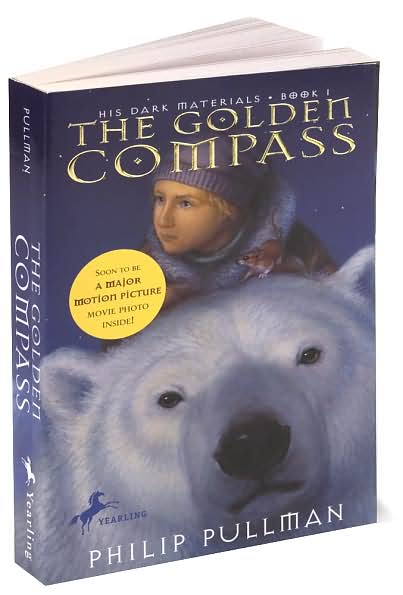
SLIS 5420 - Module 8- Book Blog - The Golden Compass


Philip Pullman is another one of my favorite authors. One of the aspects of this book I really enjoy is the fact that Lyra is a good liar. I think one important lesson students don't learn or learn in a negative way is that lying is in fact useful for survival sometimes. So many of our students have rough lives and have to lie to keep from getting themselves hurt. By discussing the lies Lyra has to tell and the consequences of those lies we can help our students see what the real world is like and what some people have to do to stay safe.

Library Uses
This would be a great discussion book for problems with authority and again to talk about lying. I'd have the students come up with lists of rules they disagree with and how they'd change those. I'd also have the students get into groups and come up with lies they think are okay to tell and have them debate with other groups about those lies. 


Reviews

Billboard - Trudi Miller Rosenblum

Pullman's fantasy masterpeice and the first of a trilogy...has become a classic of the genre.

Publishers Weekly

If Pullman's imagination dazzled in the Victorian thrillers that culminated with The Tin Princess, in this first volume of a fantasy trilogy it is nothing short of breathtaking. Here Earth is one of only five planets in the solar system, every human has a daemon (the soul embodied as an animal familiar) and, in a time similar to our late 19th century, Oxford scholars and agents of the supreme Calvinist Church are in a race to unleash the power that will enable them to cross the bridge to a parallel universe. The story line has all the hallmarks of a myth: brought up ignorant of her true identity, 11-year-old Lyra goes on a quest from East Anglia to the top of the world in search of her kidnapped playmate Roger and her imprisoned uncle, Lord Asriel. Deceptions and treacheries threaten at every turn, and she is not yet certain how to read the mysterious truth-telling instrument that is her only guide. After escaping from the charming and sinister Mrs. Coulter, she joins a group of "gyptians" in search of their children, who, like Roger, have been spirited away by Mrs. Coulter's henchmen, the Gobblers. Along the way Lyra is guided by friendly witches and attacked by malevolent ones, aided by an armored polar bear and a Texan balloonist, and nearly made a victim of the Gobblers' cruel experiments. As always, Pullman is a master at combining impeccable characterizations and seamless plotting, maintaining a crackling pace to create scene upon scene of almost unbearable tension. This glittering gem will leave readers of all ages eagerly awaiting the next installment of Lyra's adventures. 100,000 first printing; $250,000 ad/promo. Ages 10-up. (Apr.)

SLIS 5420 - Module 7- Book Blog - Hero Type


Barry Lyga is one of my new favorite authors. His style of writing is so humorous and real that I can't help but be drawn into the character's lives. This book is no exception. The main character is a teenage stalker who ends up saving the girl he stalks life from a serial killer. He is quickly exhaulted by the community but is extremely nervous that someone will find out his secret. The book takes the reader through the rise and fall of his heroism and has a very realistic ending, not cut and dry and very open-ended. One of the best books I've read in a long while.

Library Uses
I would have students research real life people who had done bad things that turned into good things and vice versa. I also think students could make short plays or skits to perform for fellow classmates. Students could also research projects that people have undertaken to help out our soldiers serving in the military. 

Reviews

Children's Literature

Kevin Ross, AKA Kross, goes from flying under the radar to hero in the blink of an eye and he is not so sure about the hero label that he has received in his hometown. Kevin has lusted after Leah Muldoon and when he saves her life, he thinks it can only get better. But Kevin has a secret and he knows that this secret would take all "hero" status away if the good people of Brookdale knew the real story. The reason he was in the "right place at the right time" was that he had been stalking Leah—for two years! As it is, he has been elevated to a higher plane where everyone knows who he is and watches what he does. Lyga has included it all: irreverence, sex, drinking, teen rebellion, with a debate on patriotism thrown in to create a very interesting problem for Kevin. Kevin's mom moved to California with his little brother after his parents divorced and Kevin lives with his father, who has a few secrets of his own. Lyga has the ability to get into a teen's mind and tell a story that is both clever and true to real life. Many teens will see themselves in this story as they read about a not so popular kid who makes it big, for a while. Reviewer: Naomi Williamson

VOYA

Kevin Ross-Kross to his friends-has a life with more ups and downs than a roller coaster. He was an average pimple-faced high schooler, living with his eccentric father and making his way through life relatively unscathed. Then he saves a girl's life, and the whole town treats him like a hero, but Kevin wonders whether the fact that he was basically stalking the girl at the time of her rescue cancels out any heroism he demonstrated. Kevin's act has earned him recognition at school, in his community, and even on a national television program. But right when he starts to feel more comfortable with the extra attention, everything comes crumbling down-not because people find out about Kevin's dark secrets but because he is caught by a photographer peeling the "Support Our Troops" magnets off the back of his car and throwing them away. Now the spotlight is back on Kevin but certainly not in a positive way. Called un-American and a traitor by the same classmates who lauded him just the week before, Kevin finds his new celebrity status is as confusing and intrusive as it was when he was called a hero. This novel proves that there are still fresh ideas and new, interesting story lines to be explored in young adult literature. Lyga revisits South Brook High School, where his previous books are set, but he takes on unchartered waters with his discussions of heroism, voyeurism, and free speech, while regular teen concerns such as bullying, cliques, friendship, and crushes maintain their relevance in the story. This book will keep readers engaged, but it will also make them think about issues big and small. It is a perfect discussion-group book and is extremely current in a unique way that is notpolitical. Reviewer: Kimberly Paone

SLIS 5420 - Module 7- Book Blog - Fat Kid Rules the World

 
This is one of those books you can't put down, that draws you in, that makes you feel sad and appreciative at the same time. Troy's life is a look at what so many teens are going through in our country. Overweight and underloved, he thinks about killing himself. One of the best lessons learned through this fantastic story is that sometimes you have to save someone else before you can save yourself. It helps show that doing for others is a rewarding and wonderful way to make your own life better. I love the musical scenes and Going does a fabulous job of describing music and particularly drumming. I think this book would particularly interest boys, but anyone who struggles with weight would do well to read this one.

 Library Uses

I would use this book with older students and have them write journal entries for times when they have been mistreated based on the way they look. I would also have the students come up with some community projects they could carry out over a semester and then have them discuss how helping others made them feel or changed their lives.


Reviews

Publishers Weekly

A fish out of water, 6'1", 300-pound Troy is on the verge of suicide-at least he believes he is-when he is inexplicably rescued by a homeless boy/legendary local punk rock musician. In PW's words, this is "a savvy and fast-paced debut." Ages 12-up. (Nov.) Copyright 2004 Reed Business Information.

Claudia Mills - Children's Literature

The main reason that 300-pound Troy Billings doesn't commit suicide by jumping in front of a New York subway train is that he is afraid people will think it's funny: "Would it be funny if the Fat Kid got splattered by a subway train? Is that funny?" But he is also interrupted by a chance conversation with another lost teen: Curt MacCrae, homeless high-school dropout, druggie, and punk-rock legend. When Curt invites—cajoles, pressures, forces—Troy to become the drummer in his not-yet-formed rock band, Rage/Tectonic, overlooking the slight detail that Troy can't play the drums, Troy's life begins to change, and Curt's does, too. Troy's retired-marine-officer dad and sneering, hostile jock brother are at first dismissive, then grudgingly impressed, and for the first time in his life, Troy is impressed with himself, too. But in the end he is going to have to risk everything to save Curt as Curt once saved him. Troy's edgy present-tense narration is punctuated by hilarious and poignant imagined headlines: "FAT KID HALLUCINATING ABOUT COOL FRIEND;" "EXULTANT FAT KID REJOICES;" "FAT KID WITH A PLAN." Going creates a completely credible picture of the New York punk-rock scene and makes us believe in Troy's bumpy journey toward becoming both a rock-band drummer and a true friend; in the process she identifies herself as one of the most promising new voices in YA fiction. 2003, G. P. Putnam,